
TCP Sticky Packets: Causes, Four Solutions and Debugging
Short answer: TCP is a byte stream and does not preserve message boundaries. Sticky packets are not a TCP bug; they happen when the application has not defined where a message starts and ends. The fix is application-layer framing: fixed length, delimiter, length prefix or a self-describing format.
What sticky and split packets look like
Suppose a client sends three messages:
Message A: hello
Message B: world
Message C: netassistant
A receiver calling recv may see:
| Case | Content returned by one recv | Symptom |
|---|---|---|
| Normal | hello, world, netassistant in three reads | Expected |
| Sticky | helloworldnetassistant in one read | Multiple messages merged |
| Split | hel, then loworld | One message split |
| Mixed | hellowor, then ldnetassistant | Both at once |
Sticky and split packets are the same problem: the receiver cannot determine message boundaries from the byte stream alone.
Why it happens
- TCP is a byte stream: it guarantees ordered, reliable bytes, not the sender's
writeboundaries - Nagle's algorithm: small writes may be coalesced before transmission
- MSS/MTU limits: large messages are segmented at the IP/TCP layer
- Receive buffer: the kernel may merge multiple arrivals, so one
recvcan return several messages - Back-to-back writes: a loop of small
sendcalls is a common trigger
The key point: disabling Nagle or sleeping between sends only reduces the probability. It does not guarantee one send maps to one recv.
Four framing solutions
1. Fixed length
Every message has the same length, padded with spaces or zeros if needed.
- Pros: simplest and fastest to parse
- Cons: wastes bandwidth and is inflexible
- Best for: fixed-format binary commands and legacy industrial protocols
2. Delimiter
Use a special character or sequence as the end marker, such as \n, \r\n, \0 or a custom delimiter.
- Pros: readable and easy to inspect
- Cons: content must escape the delimiter; not suitable for binary data
- Best for: AT commands, logs, JSON Lines and other text protocols
3. Length prefix
Prefix each message with a fixed-size length field. The receiver reads the length first, then exactly that many payload bytes.
+----------+------------------+
| 4B length|   N bytes payload |
+----------+------------------+- Pros: binary-friendly, efficient and unambiguous
- Cons: both sides must agree on byte order, field size and maximum frame length
- Best for: custom binary protocols, RPC, game protocols and IoT device protocols
4. Self-describing format
Use JSON, Protobuf or MessagePack so the parser can tell when a complete object ends. Note that JSON over TCP still needs framing, usually a newline or a length prefix.
- Pros: extensible and easy to evolve
- Cons: higher parsing cost; JSON is verbose
- Best for: configuration, business messages and debugging APIs
Comparison
| Solution | Boundary | Pros | Cons | Typical use |
|---|---|---|---|---|
| Fixed length | Fixed byte count | Simplest, fastest | Inflexible, wasteful | Fixed commands |
| Delimiter | Special character | Readable | Escaping needed, not binary-safe | Text protocols, logs |
| Length prefix | Length field | Binary-friendly, efficient | Byte order and limits must be defined | Custom binary protocols |
| Self-describing | Structure itself | Extensible | Parsing cost and size | JSON/Protobuf messages |
Code examples
Length prefix: Python receiver
import struct

MAX_FRAME = 1024 * 1024  # 1 MiB, prevents memory abuse

def recv_exact(sock, n):
    buf = b""
    while len(buf) < n:
        chunk = sock.recv(n - len(buf))
        if not chunk:
            raise ConnectionError("connection closed")
        buf += chunk
    return buf

def recv_frame(sock):
    header = recv_exact(sock, 4)
    (length,) = struct.unpack(">I", header)  # big-endian uint32
    if length > MAX_FRAME:
        raise ValueError(f"frame too large: {length}")
    return recv_exact(sock, length)
The sender writes struct.pack(">I", len(payload)) + payload.
Delimiter: split on newline
buffer = b""

while True:
    chunk = sock.recv(4096)
    if not chunk:
        break
    buffer += chunk
    while b"\n" in buffer:
        line, buffer = buffer.split(b"\n", 1)
        handle(line)  # process one complete line
Keep the unfinished tail in buffer; do not clear it after every recv.
Debugging sticky packets with NetAssistant
NetAssistant provides four receive-side decoders, so you can compare raw bytes with framed messages:
- Create a TCP client or server connection
- Choose Raw / Line-delimited / Length-prefix / JSON as the decoder
- Send test traffic and check whether the receive view splits messages correctly
- Switch to hex mode to inspect length fields, delimiters and byte order
- Use search, favorites and export to investigate long-running sessions
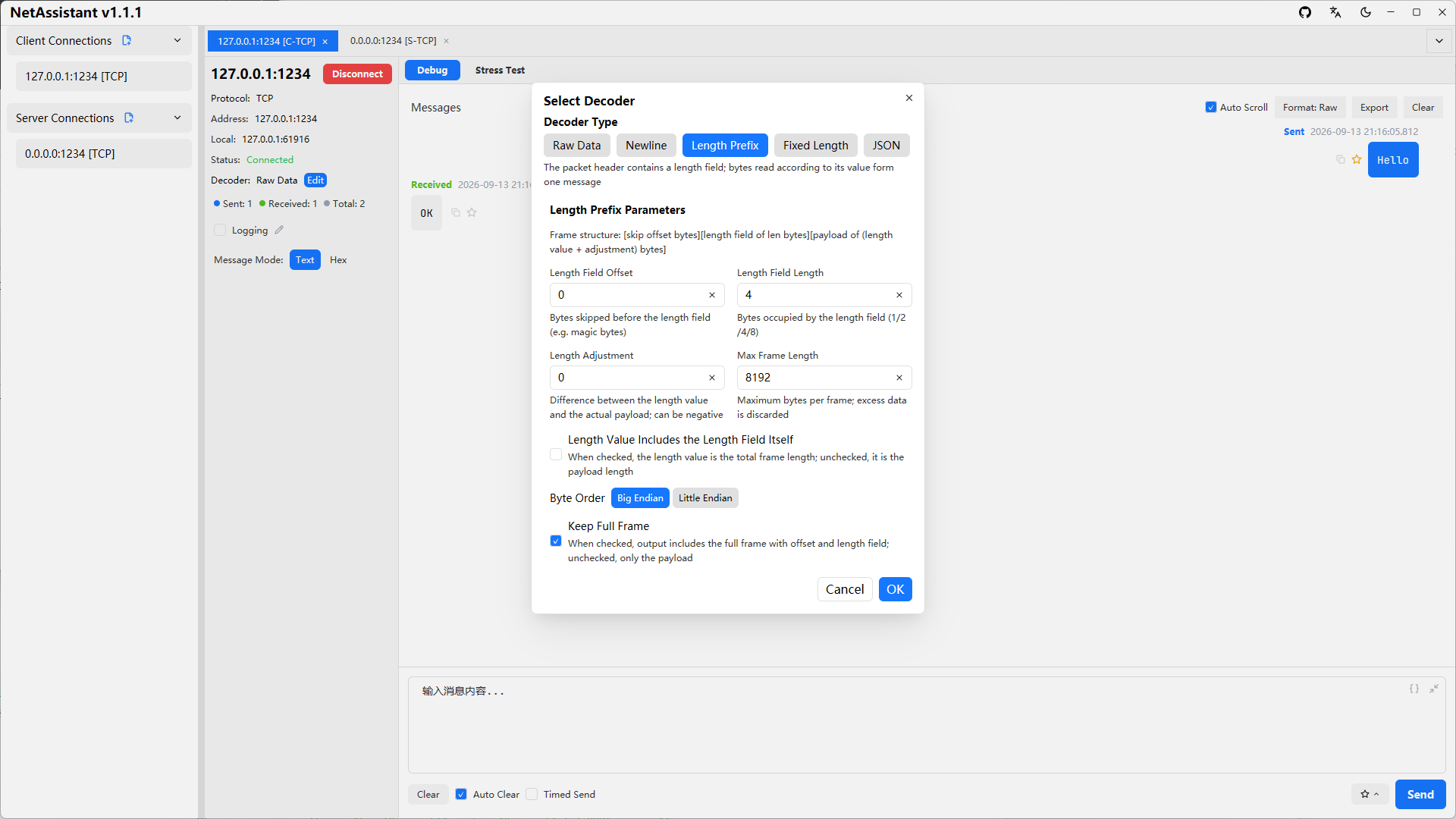
The length-prefix decoder needs the field size and byte order; the line decoder needs a delimiter; the JSON decoder frames complete JSON objects.
Common misconceptions
- "Sticky packets are a TCP bug": no. TCP provides a byte stream; framing belongs to the application
- "A bigger receive buffer fixes it": buffer size changes timing, not message boundaries
- "Sleep after every send": only lowers the probability, does not guarantee correctness
- "UDP has sticky packets too": UDP is datagram-oriented and preserves message boundaries; it has loss, reordering and fragmentation issues instead
- "HTTP has no problem, so TCP is fine": HTTP defines Content-Length, chunked encoding or frame lengths. That is exactly application-layer framing
FAQ
What is the difference between sticky and split packets?
Sticky packets merge multiple messages into one read; split packets divide one message across reads. Both mean the application has not defined message boundaries.
Why does it work locally but fail in production?
Local tests often have small writes and large gaps, so one send tends to map to one recv. In production, Nagle, buffer coalescing, latency and concurrency change read boundaries.
Should a length prefix be big-endian or little-endian?
Either works if both sides agree, but big-endian network byte order is the common convention. Use a 4-byte unsigned integer and enforce a maximum frame size.
What delimiter should I use?
Choose a sequence that cannot appear in the payload. Text protocols commonly use \n or \r\n; if the payload can contain it, escape it or use a length prefix instead.
Why does HTTP not have sticky packets?
HTTP defines message boundaries at the application layer with Content-Length, chunked encoding or length-prefixed frames.
Does UDP have sticky packets?
No. UDP preserves message boundaries, but it can lose, reorder or duplicate datagrams and may fragment above the MTU.